
How to play Plinko on Hollywoodbets: Split The Pot rules
Document walkthrough, not a recorded account session: the operator-hosted Split The Pot PDF describes Standard and Advanced modes on pages 39 to 41. For Standard play, set the stake, choose the 8 to 16 setting the PDF calls buckets, select Easy, Medium or Hard, then press Play. The landing bucket determines the result.
The document allows additional balls while one is moving, and describes three animation speeds. Advanced mode includes a round count, maximum stake and actions after wins or losses. Those controls automate betting; they do not establish a profitable strategy.
The PDF also contains apparent copy inconsistencies: its Plinko section refers to Start climbing and rolling numbers. We preserve that discrepancy rather than pretending the wording matches a live Plinko interface. Confirm labels and settings in the game that actually opens. We have not verified this version’s RTP.
If a Plinko bet request is not accepted
Do not keep pressing Play while a request is unresolved. Check the game’s history and account balance before trying again so that a delayed result is not mistaken for a rejected bet. Keep the displayed error, time and any round reference for operator support.
We have not identified a distinct official product called Request Plinko Bet. If that wording appears in an error or search result, the exact operator and message are needed to explain it. It does not establish a separate game or a legitimate support website.
See the real BGaming controls change
The control labelled Lines selects the number of peg rows in this version. It is not a slot payline selector. The highlighted choice changed from 8 to 16 in our captures. Low, Normal and High are separate risk controls.
What do I press, and what does it mean?
Original BGaming Plinko, 16 rows and High risk. The arrows and labels are our explanatory overlay; the screenshot underneath is unchanged.

Choose rows
The control says Lines. Here it means peg rows, not slot paylines. Our example has 16 selected.
Choose risk
Low, Normal and High change the payout strip. High does not mean a higher chance of profit.
Check the stake
This screen says 1.00 FUN. That is a demo-credit stake, not R1 and not a cash-game minimum.
Read the pockets
The number under each pocket multiplies your stake. A 0.2x return gives back only one fifth of it.
Then press Play
The ball lands in a pocket. Read the resulting payout and subtract the stake to find the net result.
A payout is not always a profit.
Hypothetical R10 stake, with no extra feature multiplier:
R2 returned − R10 staked = R8 lost.
At 1x, the same stake returns R10: break-even. At 2x it returns R20: R10 profit. These explain arithmetic, not observed results or the chance of any pocket.
Change the numbers in the calculator →We opened the original BGaming demo and changed its visible controls on 9 October 2026. These are actual interface captures, with no balls released and no payout-frequency study.
At 16 rows, switching Low to High also changed the centre from 0.5x to 0.2x. A bigger headline maximum comes with a different payout strip. It does not tell you the probability of landing there.
8 rows / Low
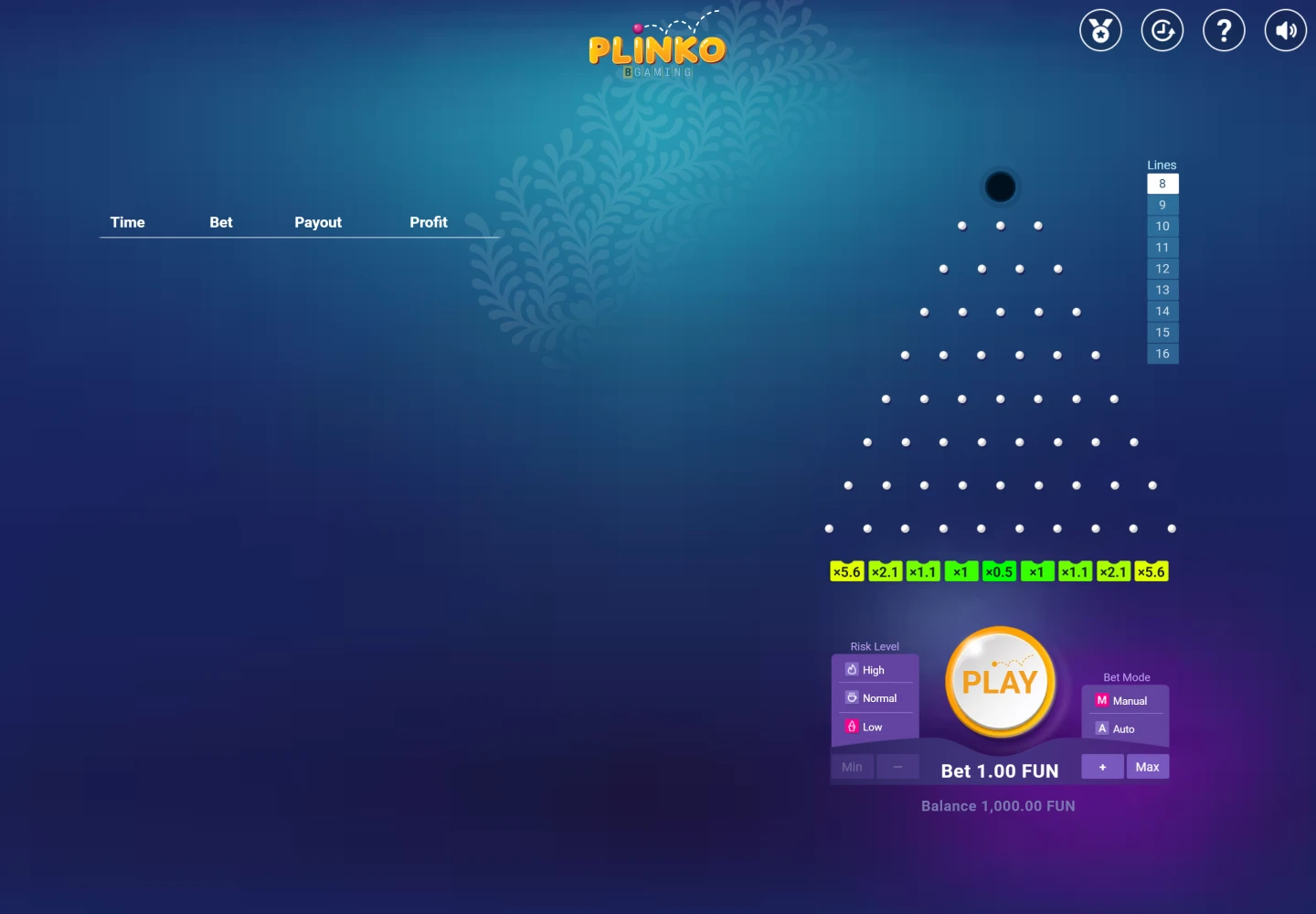
Read all 9 displayed pocket multipliers
- Pocket 15.6x
- Pocket 22.1x
- Pocket 31.1x
- Pocket 41x
- Pocket 50.5x
- Pocket 61x
- Pocket 71.1x
- Pocket 82.1x
- Pocket 95.6x
Left to right. These pockets are not equally likely simply because they have equal widths on screen.
16 rows / Low
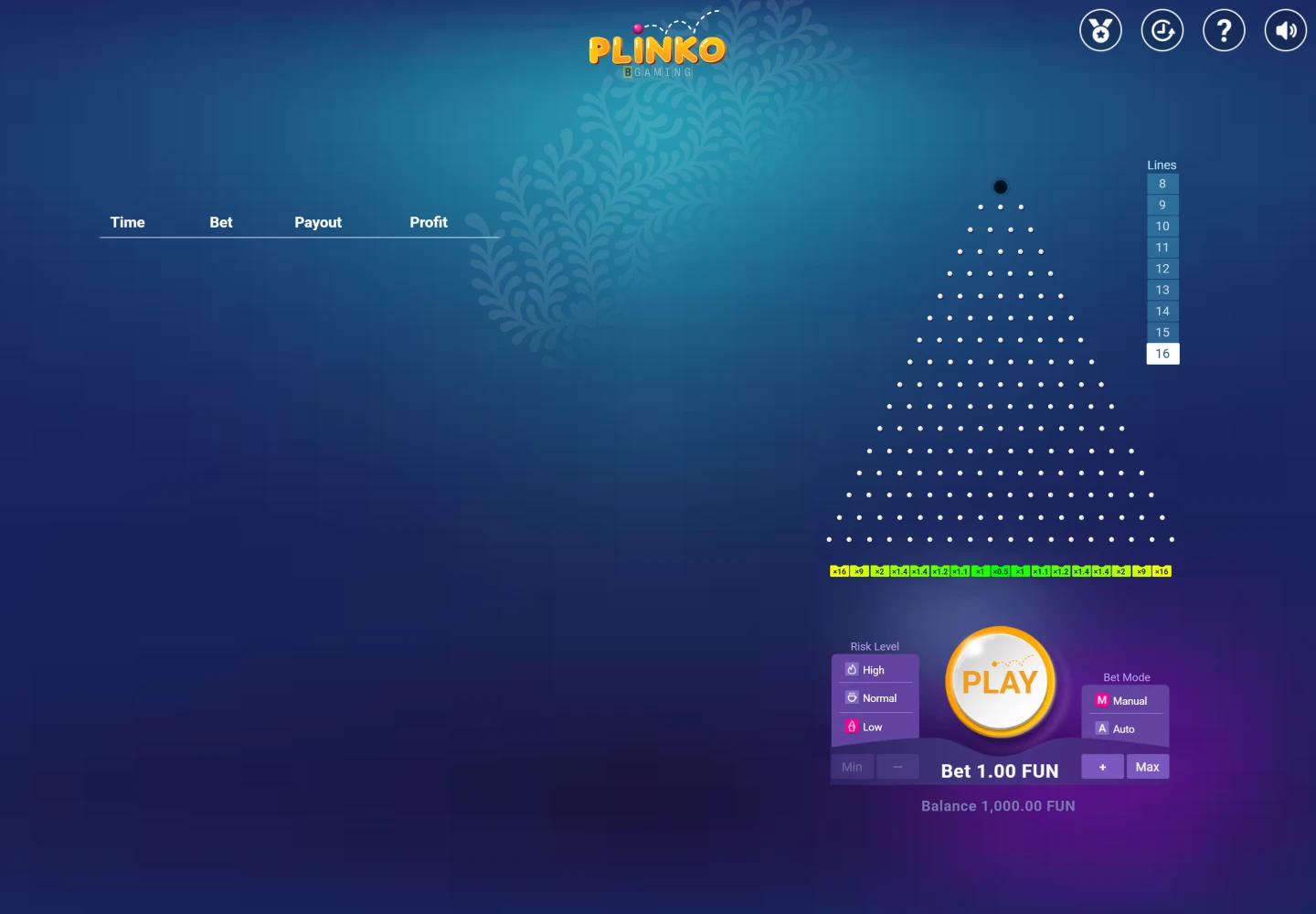
Read all 17 displayed pocket multipliers
- Pocket 116x
- Pocket 29x
- Pocket 32x
- Pocket 41.4x
- Pocket 51.4x
- Pocket 61.2x
- Pocket 71.1x
- Pocket 81x
- Pocket 90.5x
- Pocket 101x
- Pocket 111.1x
- Pocket 121.2x
- Pocket 131.4x
- Pocket 141.4x
- Pocket 152x
- Pocket 169x
- Pocket 1716x
Left to right. These pockets are not equally likely simply because they have equal widths on screen.
16 rows / High
Read all 17 displayed pocket multipliers
- Pocket 11000x
- Pocket 2130x
- Pocket 326x
- Pocket 49x
- Pocket 54x
- Pocket 62x
- Pocket 70.2x
- Pocket 80.2x
- Pocket 90.2x
- Pocket 100.2x
- Pocket 110.2x
- Pocket 122x
- Pocket 134x
- Pocket 149x
- Pocket 1526x
- Pocket 16130x
- Pocket 171000x
Left to right. These pockets are not equally likely simply because they have equal widths on screen.
Download the transcribed settings · Verify checksums · Provider reference
Read the screen before pressing Play
The stake is below the Play button, with minus, plus, Min and Max controls. Our capture shows Bet 1.00 FUN and Balance 1,000.00 FUN. FUN identifies demo credits; those values are not verified South African cash-game limits.
The bottom payout strip belongs to the selected rows and risk. At 8 rows and Low, our screenshot has nine pockets; at 16 rows it has seventeen. Count the displayed pockets rather than borrowing a payout table from a different provider.
The empty history panel has separate Bet, Payout and Profit columns. It is empty because we did not release balls in this inspection. For arithmetic illustration, a 1 FUN stake landing at 0.5x would return 0.5 FUN and lose 0.5 FUN net; that is not a captured outcome.
Rules, automatic play and the mobile limitation
The question-mark control opened English in-game rules. The help describes Low, Normal and High, 8 to 16 rows, and Manual or Auto mode. We inspected the rules and manual controls; we did not run automatic play or test its stopping behaviour.
At an emulated 390 by 844 portrait viewport, this desktop Chrome session scaled the board and controls down substantially. That is a readability limitation in this setup, not evidence of a physical-phone test. Open the provider demo and check whether its controls are comfortable on your actual device before using them.
These screenshots belong to original BGaming Plinko. They do not show the BetGames Golden Ball feature, and they do not verify the Split The Pot version listed by Hollywoodbets.
1. Identify the game before changing settings
Look for the provider name in the lobby or help menu. Then find its payout table, available rows, risk options and stake controls. These details are version-specific.
For the BetGames rules we reviewed, row and risk settings cannot change while balls are still active. Finish the current round before altering the board.
2. Rows change the board
Rows are levels of pegs, not slot paylines. More rows create a different set of landing pockets. In the cited BetGames rules, an additional row adds one available multiplier position.
Do not infer exact landing odds just from the drawing. A fair-coin branching diagram can illustrate a mathematical idea, but it is not proof of a commercial game’s outcome distribution.
3. Read the payout strip after choosing risk
Risk settings alter the multiplier arrangement. Before releasing a ball, inspect both the small returns and the large edge values. A prominent top multiplier tells you nothing by itself about how often it occurs.
Use a fixed spending and time limit. Autoplay or a faster animation can increase how many paid rounds happen in a short period; it is not evidence of better returns.
4. Payout is stake multiplied by the result
For a simple landing payout, stake × multiplier = credits returned. Net result is the returned amount minus the stake. R10 at 2x returns R20, a R10 net gain; R10 at 0.5x returns R5, a R5 net loss.
These are arithmetic examples, not observed rounds, a payout forecast or supported operator stake limits. A special feature can require another factor, so check its exact rule.
Can a Plinko strategy guarantee a win?
No verified method in our research guarantees a future result. Increasing the stake after a loss increases the next amount at risk. A run of low payouts does not establish that a large one is due.
Choose settings to understand the possible outcomes, not because a tipster promises a winning hour. Treat predictors, paid signals and guaranteed-withdrawal claims as claims requiring evidence.